Many industrial processes need materials to be compacted, settled, or densified before moving to the next stage of production. Air voids, uneven filling, and inconsistent density of material can affect the quality and performance of the product. To address these challenges, industries use a vibrating table.
These tables are used in a wide range of applications, from precast concrete and paver blocks to foundry operations and packaging. Depending on their design and operational parameters, industries also use them for vibration testing to check how products and packages respond to vibrations during transportation and handling.
In this guide, let’s learn about these vibration tables, their operating mechanisms, and their various testing applications.
What is a Vibrating Table?
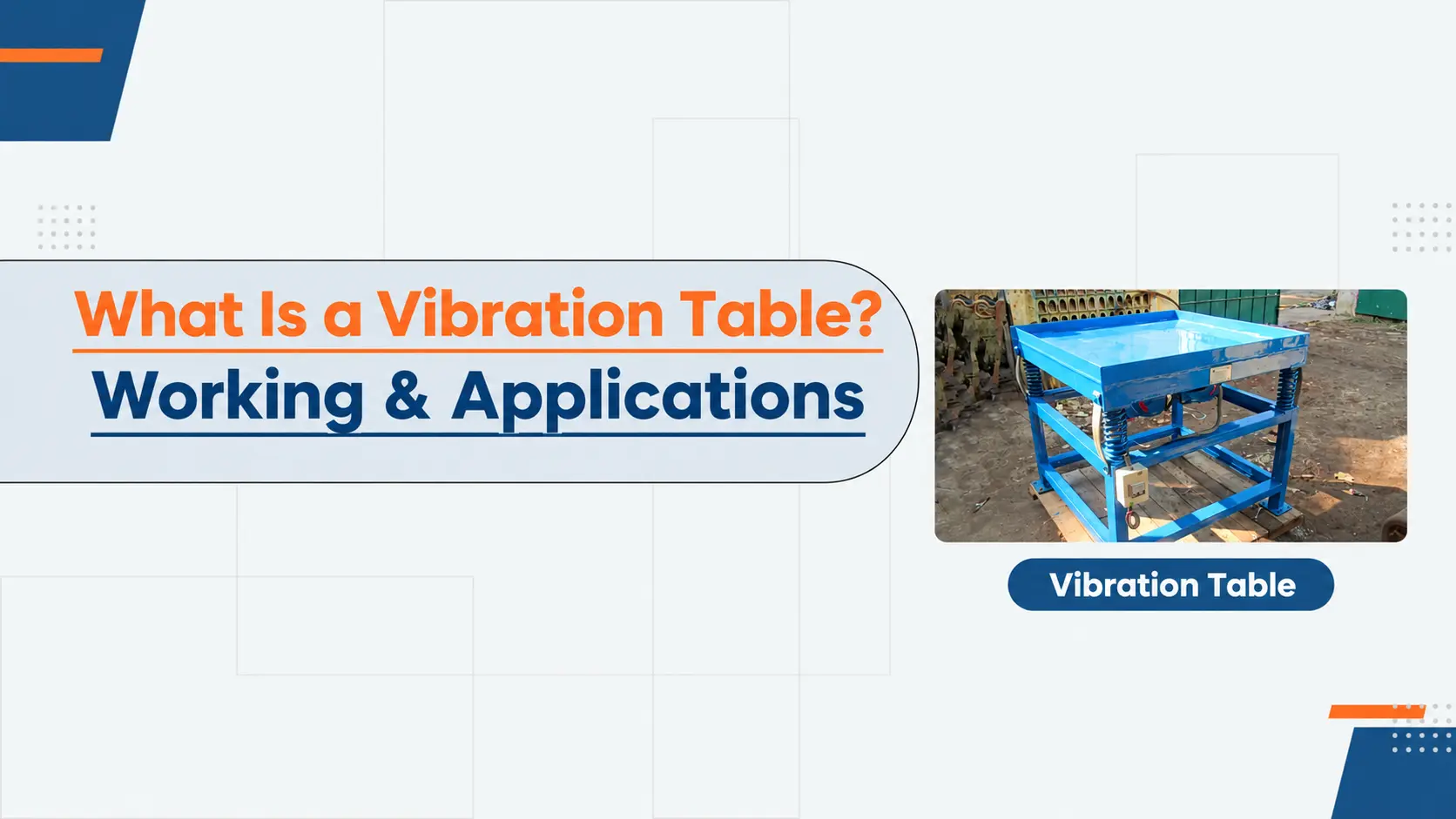
A vibrating table, also known as a vibrating compaction table, is an industrial machine that generates controlled vibratory movement. Once materials, moulds, containers, or products are placed on the platform, they are subjected to vibrations, which cause the particles or material to move and rearrange.
This helps reduce air gaps between particles, improve settling, increase material density, and create a more uniform distribution. These tables can be designed for different loads, platform sizes, and vibration intensities, as they have to serve different purposes depending on the application.
How Does A Vibration Table Work? Working Mechanism Explained
The working mechanism of an industrial vibrating table is based on controlled mechanical vibrations. The vibration-generating system transfers oscillating movement to the platform, causing the material or the product on it to experience repeated movement.
Here is a step-by-step working process of a typical compaction table:
- Firstly, the material, whether it’s a mould, container, packaging unit, or product, is positioned securely on the platform.
- Secondly, the electric motors fitted with eccentric weights generate centrifugal force to move the platform as the weights rotate.
- Thirdly, the vibrations are transmitted to the platform, but the support system of the table limits the transmission of excessive vibrations.
- As the platform vibrates, the particles within the material begin to move and settle, reducing trapped air to let the material occupy the available space.
- Soon, compaction and settling take place as vibration continues and the material is uniformly distributed.
- A timer or a control system is used to maintain a consistent vibration cycle. Once the required level of compaction is achieved, the vibrations stop, and the material or container is removed.
The vibration frequency and operating time are adjusted in vibration tables according to the requirements of the application.
Main Applications of Vibration Tables
Vibration tables are used wherever bulk material needs to be settled, compacted, densified, or subjected to controlled vibration. Some important applications are:
- Precast Concrete Products – To remove air voids from precast concrete mixtures, promote material settlement, and improve surface finish, these tables are used for this application.
- Paver Blocks and Interlocking Tiles – During concrete product manufacturing, a heavy duty vibrating table is used to distribute and compact the concrete inside the mould.
- Foundry Sand Mould Compaction – To create a stable mould, the foundry sand must be compacted. Controlled vibration of compaction tables distributes the sand and achieves more uniform compaction.
- Pharmaceutical Powder Densification – To improve packing density, vibratory tables are used; they reduce trapped air between particles of fine powder, making them useful for pharmaceutical powder densification.
- Industrial Material Settling – These tables are also used for general material settling and compaction where consistent packing or densification is required.
What is Vibration Testing?
Vibration testing is a process where a product, component, or package is subjected to specific vibration frequencies to evaluate how it responds. This process is not the same as compaction; instead, the product is placed on the table for us to understand its durability, stability, structural integrity, and performance when exposed to vibration.
By observing the products during this vibration test, manufacturers identify weaknesses in them and make improvements. The testing parameters include factors such as:
- Vibration frequency
- Amplitude
- Test duration
- Load
- Vibration direction
- Test cycle
Testing Applications of a Vibrating Compaction Table
Although a vibration table machine is mainly used for industrial material compaction, the basic principle of controlled vibrations can also be applied for testing and evaluation of products. For example:
Manufacturers expose different packages to vibrations to determine whether they can withstand repeated movements, and to compare different designs to find which one provides better protection for the product.
Product Stability Testing
Manufacturers also use the vibration table testing method to evaluate whether a product remains stable during repeated movement. This is important for products that are transported over long distances.
Transportation Simulation
Products and packages experience continuous vibration during transportation; through vibration testing, we can determine whether they can withstand transportation.
Component Durability Testing
Manufacturers can test certain components and assemblies to identify loose connections, structure weaknesses, or other failures through vibration testing.
Vibration table testing can be a part of the quality-control process, where manufacturers can verify the stability and durability of their products and packaging before dispatch.
A Reliable Vibrating Table Manufacturer: Vibro Flux
For industries and specific production requirements, you need a reliable manufacturer that understands the material, load, operating cycle, and required compaction.
At Vibro Flux, our industrial vibrating tables are designed with robust platform construction, so they can withstand continuous industrial use. Moreover, they can be configured according to factors such as size, load capacity, and vibration requirements. There are also features like adjustable vibration, timers, and customised layouts.
Choose the Right Vibration Table for Your Application
A vibration table machine is an important part of the industrial process where materials need to be compacted, settled, densified, and evaluated through controlled vibrations. Whether for a foundry or pharmaceutical production, the right vibration conditions can improve consistency and support more reliable production.
These controlled vibrations also help manufacturers test products or packaging. If you are looking for a vibration compaction table, contact us at Vibro Flux today and receive professional guidance.