
What Is Vibrating Equipment in Material Handling and Its Uses?
Most industries that handle heavy materials have a continuous need to move these materials from one stage of production to another. With efficient material handling, industries can maintain a consistent production rate, reduce material loss, and minimise unnecessary downtime. And this is where vibrating equipments play an important role.
By using controlled vibrations, they move, feed, screen, and separate materials according to the product size and production requirements. Unlike traditional conveyor systems that primarily focus on transporting materials, vibratory equipment requires minimal manual assistance and can operate alongside other processes, such as grading.
In this blog, let’s learn about vibrating equipment, their different types, and how to use vibration machines.
Understanding Vibrating Equipment
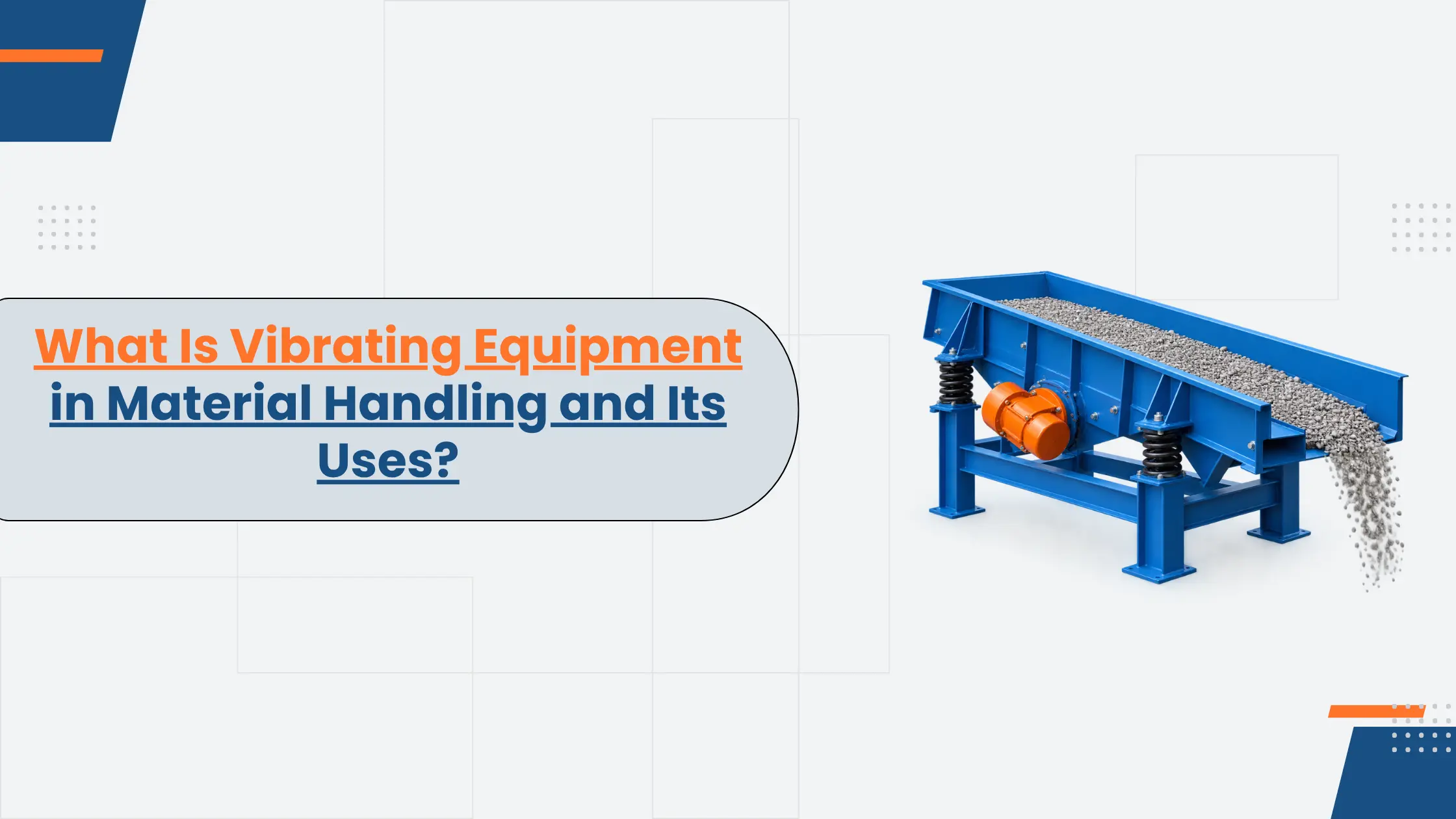
Vibrating equipment is industrial machinery that uses controlled vibrations to move or process bulk materials. The basic principle here is relatively simple: the equipment generates controlled oscillating movement to transform it to a trough, screen deck, table, hopper, or other surface. As the machine vibrates, the material moves in a controlled direction or interacts with a screening surface.
The exact movement of materials depends on various factors such as vibration frequency, amplitude, direction, and the physical properties of the material. Moreover, these different vibratory machines can perform various tasks such as separating materials according to their sizes, compacting and settling other materials, and providing a continuous and controlled flow of them.
Types of Vibratory Equipment in Material Handling
There are different types of industrial vibrating equipment for different configurations. The various production processes determine what type of equipment is better suited.
Vibrating Feeders
Vibratory feeders are machines that provide a controlled and continuous flow of bulk materials from one point to another. They are useful when a process requires a regular feed rate rather than uncontrollable discharge of material. Moreover, they reduce spillage and other interruptions in production; mostly used in mining, crushing, and recycling applications.
Vibratory Tables
Also known as compaction tables, they are used to settle down the product and reduce air voids. The controlled vibrations in these machines help remove trapped air from products such as mould filling, concrete, powder, etc., to achieve more uniform packing.
Vibrating Screens
These vibrating screens, also known as screen separators, use vibrations to separate materials according to their particle size. They are used for grading, removing unwanted particles, and preparing materials for subsequent processing. They are mostly used in mineral processing, mining, food processing, chemical processing, recycling, etc.
Vibratory Conveyors
These conveyors use controlled vibrations to transport bulk materials. Depending on the design, the conveying process can also be combined with operations such as sorting, drying, or cleaning.
Bin/Hopper Vibrators
Bin/Hopper vibrators use vibrations to assist material flow in storage equipment to material bridges, rat holes, and buildups in the equipment. They are useful to handle powders, granular materials, cement, chemicals, and other bulk solids.
Vibratory Furnace Chargers
These chargers are designed to feed materials into the furnace in a controlled and consistent manner. Designed for this purpose, they provide controlled feed rates, improve furnace productivity, and reduce material loss.
Different Uses of Vibration Equipment in Material Handling
There are different uses of vibrating equipment at different stages of an industrial process:
Controlled Material Feeding
This is one of the most common uses of vibratory equipment, to control the feed rate of material in a process. This controlled feed rate helps downstream equipment to operate more efficiently.
Conveying Bulk Material
In a production process, there are always different stages where material needs to be transported from one stage to another. This is where vibration equipment is used. Their vibrations easily transport bulk solids forward in the production line.
Screening and Separation
Vibratory equipment is also useful for screening and separating materials according to their particle size, which is useful in mineral processing, food processing, aggregate production, and other applications.
Preventing Material Flow Problems
Bulk material flow sometimes stops due to bridging, rat-holing, or buildup; equipment such as bin/hopper vibrations helps with this. Their controlled vibrations assist material discharge and maintain a consistent flow from storage vessels.
Compaction and Densification
Industries use vibration equipment such as a vibrating table for the compaction of products. As controlled vibrations remove trapped air, it helps materials settle down. This is useful in applications such as mould filling, concrete products, and powder densification.
Furnace Charging
Vibratory chargers allow consistent material feeding in furnaces, which is important in foundry and steel processing operations to carefully maintain material feed.
Reliable Vibrating Equipment Supplier in India: Vibro Flux
To select the right vibrating equipment for your industry, you need to consider various factors, one of which is choosing the right vibratory equipment supplier in India. At Vibro Flux, we bring heavy-duty and high-performance designs. Our bulk material-handling equipment is built for tough operating conditions and demanding industrial environments.
Alongside our various vibratory equipment, such as feeders, tables, and conveyors, for material handling, we also provide installation and commissioning, spare parts and accessories, and other custom engineering services. We prove our reliability with our after-sales support, where you can work directly with the engineering team that will design and build your equipment.
Improve Your Material Handling Process with the Right Vibrating Equipment!
In the material handling industry, vibratory equipment has become an important part of the process. Their controlled vibrations do more than just move the material. Depending on the installed equipment, design and need, they can control feeding, screening, separation, conveying, material discharge, compaction and other work.
However, for a better work process, it is necessary to select them while considering some factors, such as the production process, available space, particle size, etc. Among these, you also need to carefully select the right vibrating screen manufacturer in India, such as Vibro Flux. The right manufacturer will not just offer reliable vibrating equipment solutions but also provide guidance on how do you use a vibration machine!
Recent Blogs