
What Is a Vibratory Feeder? Types, Applications, and Working Principle
In industries where material handling is a constant task, maintaining a consistent flow of material is essential to keep production lines efficient and reliable. Whether the material is a mineral, powder, grain, chemical, aggregate, or some other material, uncontrolled feeding of it can lead to blockage, equipment overload, material wastage, production interruptions, time delays, and maintenance costs.
To overcome these issues, industries use vibratory feeders, a machine that regulates the flow of materials. In this guide, let’s learn what an industrial vibratory feeder is, its types, applications, and working principle.
Understanding Vibratory Feeders
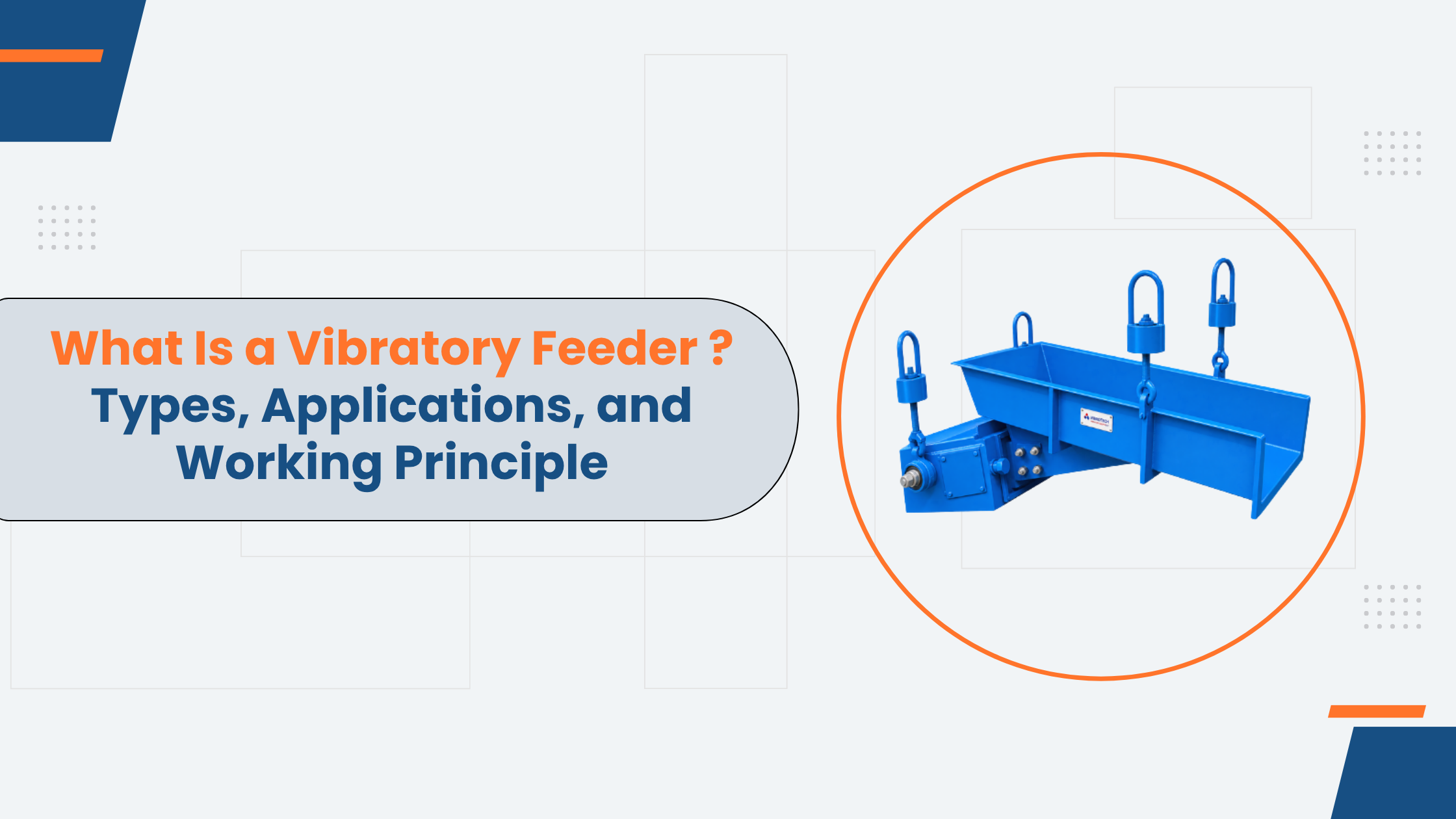
Vibrating feeders are machines that use controlled vibrations to transport and regulate the flow of bulk materials from one place to another. They are commonly installed below hoppers, bins, and silos, or above crushers, screens, conveyors, mixers, and processing machines to provide regular feed of material. Depending on their designs, these feeders can handle materials from fine powders to larger abrasive particles.
In simple terms, they start operating once material is placed into the feeder tray or trough; their drive mechanism then generates vibrations that cause the trough to oscillate. Then the combined effect of vibration and gravity moves the material forward at a controlled rate toward the discharge point.
Different Types of Vibrating Feeders
Vibration feeders are classified according to their drive mechanism, operating principle, and application. The most common types of vibrating feeders are:
Electromagnetic Vibratory Feeders
Feeders that use electromagnetic drive to generate vibration are called electromagnetic vibratory feeders. The electromagnetic force in them causes the feeder tray to oscillate at a controlled frequency. One of their characteristics is their precise control of material flow. You can adjust the feed rate by controlling the electrical input to the drive.
Electromechanical Vibratory Feeders
For industries requiring continuous, robust material feeding, electromechanical feeders are the best choice. They use electric motors and unbalanced weights to produce vibrations. Depending on their design, single or multiple motors can be used. Lastly, they are commonly used for applications involving aggregates, minerals, bulk solids, etc., where durability and reliable material flow are necessary.
Natural Frequency Vibratory Feeders
Also known as resonance-type feeders, they are designed to operate close to the natural frequency of their spring systems. To achieve the required vibratory movement efficiently, the spring system stores and releases energy during each operating cycle. For energy efficiency and controlled material movement, this type of feeder is the best choice.
vibration table machine
This feeder combines feeding and preliminary screening. It has a feeding section and grizzly bars; while the feeding section moves material forward, grizzly bars let only the small particles pass through, separating the oversized material. This arrangement is particularly useful in mining, quarrying, mineral processing, and other applications.
How Do Vibratory Feeders Work? Working Principle
The electromagnetic vibratory feeder working principle is based on the controlled movement of a feeder trough or tray. Since a typical system consists of a trough, drive mechanism, springs, supporting structure, and vibration-generating components, the process generally works as:
- The bulk material is discharged from the inlet onto the feeder trough.
- An electric motor or another kind of drive creates controlled vibratory motion.
- The vibration transfers to the feeder tray, producing controlled movement.
- Vibration and gravity cause the material to go through the desired path.
- Lastly, the material leaves the feeder at a controlled rate and enters the next stage of the production process.
The movement and the feed rate depend on several factors, such as the vibration frequency. The vibratory feeder controller working principle and controlled movement make them useful for applications where simply opening a hopper would not provide enough control.
Application of Vibrating Feeders
There are many industries that use these feeders for their controlled, continuous, and reliable material flow. Some of their applications are:
Mining and Mineral Processing
For mining and mineral processing, where large quantities of ores, minerals, rocks, aggregates, and other materials are handled on a daily basis, using vibrating feeders becomes essential as they can easily and quickly transfer material from one part of the processing equipment to another.
Aggregate and Quarrying
In aggregate plants where consistent feeding is necessary to maintain the performance of crushers and screens, vibratory feeding machines regulate the supply and in some configurations, they can even remove fines or oversized material.
Food Processing
Vibration feeders provide consistent material flow in food processing where controlled and frequent feeding of grains and other materials is required. Moreover, these feeders also allow the feeding process to be integrated with screening, weighing, packaging, and other production stages.
Chemical and Pharmaceutical
In chemical and pharmaceutical processes, vibratory machines provide accurate handling of powders and granular materials; they also control the material flow into the downstream machinery. Their equipment construction and material selection can be adapted according to the application’s hygiene, chemical compatibility, and other requirements.
Foundries and Metal Processing
Feeder systems provide controlled material transfer and can be integrated into charging, screening, cooling, and other processes for handling bulk solids in foundries and metal processing.
Recycling
These machines can regulate the flow of material to sorting and separation equipment to support a consistent feed rate of materials that can vary in size, shape, and composition in recycling applications.
Construction and Building Material
In construction work, you can install the feeders beneath storage hoppers or silos to provide a steady supply to conveyors, screens, mixers, and other systems.
Reliable Vibrating Feeder Manufacturer: Vibro Flux
Vibrating feeders are important in many applications and industries; however, for them to work efficiently, you need to consider factors such as your installation location, required size, feed rate, and a reliable vibro feeder manufacturer India.
At Vibro Flux, every feeder machine is designed according to your material properties. The machines here are manufactured using premium-quality materials with optional wear liners. Furthermore, they provide comprehensive guidance and after-sales services for their customers.
Choose the Right Vibration Feeder for Your Production!
A vibration feeder is more than just a material transfer machine; it is an important part of a controlled material-handling system. They help regulate the flow of bulk materials and maintain a consistent supply to the downstream equipment.
From mining and aggregates to food processing and recycling, these feeders can adapt to a wide range of industrial requirements. If you are looking for the right feeder for your industry, contact Vibro Flux, the most reliable vibro feeder manufacturer in India. Consider your requirements and choose the right solution today!
Recent Blogs